

If you have central AC in your home, you’ve likely heard the term before. A capacitor is a crucial component to both keep your unit running properly and protect it from issues. At the Jersey Shore, it is one of the most commonly replaced parts and can be responsible for full system breakdowns.
Let’s take a look at what they are and how they work.

What Does a Capacitor Do?
The easiest way to explain what a capacitor does for your AC unit is to relate it to a battery. The AC condenser (or outside unit) is likely on a dedicated electrical run directly from the electrical panel, providing it with the same consistent amount of power required for operation. However, when your thermostat initially calls for cooling in your New Jersey home, your condenser needs an extra kick of power to get itself going. The capacitor (which is sort of shaped like a battery as well) stores a small amount of energy to provide that bonus needed to get the condenser running.
The components of your AC systems are also extremely temperamental. From fan motors to compressors, they can be expensive to repair. Certain kinds of capacitors will also maintain a constant, even flow of electricity to prevent fluxes that can damage them.
How Often Do I Need to Replace My Capacitor?
The average capacitor will last anywhere between 5-10 years, but will vary dramatically depending on a number of factors. For example, hot climates and humidity will wear down capacitors quicker, while mild temperatures might prolong the lifespan. Ocean air like that at the Jersey Shore can be corrosive as
well. Capacitors are considered wear-and-tear and are often designed to be easily replaced.
Signs That Your Capacitor is Failing
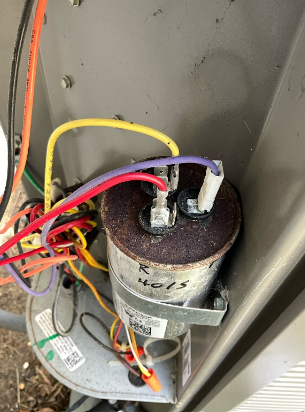
When installed properly, the capacitor will be within your condenser, likely hidden behind the panel on the side. For that reason, we usually recommend having a professional HVAC technician on site to check on its status. However, your capacitor will begin to leak or expand/bulge as it begins to decline. Traces of rust can also point to an older unit. That being said, even capacitors that are in perfect physical condition can fail, which is why a properly trained service technician will be able to tell you the exact status.
Should I Replace My Capacitor Before It Fails?
During proper HVAC Maintenance, your technician may recommend replacing the capacitor. Like many local, family-owned HVAC companies, Rostron Premium Home Services includes checking the capacitor as part of the AC Maintenance checklist. Their recommendation is likely based on the discovery of signs of failure. A failed capacitor will end with a full breakdown unless caught early. Proper AC Maintenance will allow
you to avoid preventable repairs, as well as get ahead of those that cannot be ignored, like a failed capacitor.

Are Capacitors Covered Under Warranties?
Warranties will vary depending on brand and installing company, so there is not a definitive answer to this question. Some manufacturers will consider capacitors as a wear-and-tear part, meaning they need to be replaced at regular intervals. Others might cover them for the full parts warranty period, while
others will mark them as a “limited” part and only include them for a portion of the full period.
Run Capacitor Versus Start Capacitor
Just as we discussed above, differing types of capacitors will have their own specific purposes. For example: Start Capacitor: Stores a small amount of energy to be expelled when the unit is starting up, allowing for a smooth turn-on process Run Capacitor: Will absorb and expel electricity as needed, providing a constant, even flow of power to the unit to protect against abnormalities Depending on the type of unit at your home, there is a chance you may not both types attached to your unit. Most newer units that are considered high efficiency will not need a start capacitor. One of the
most common reasons for that are multi-stage units, that will start off at a lower capacity and work their
way up, meaning that they don’t need that extra burst to get themselves going. There are occasions when these start capacitors are required for high efficiency units as well. If the start capacitor was not a component of the initial unit, then a hard-start kit would be required for the extra power. There are such things as dual capacitors as well, which can act as both.
Haven’t Replace Your Capacitor Recently?
A proper AC Maintenance with a Rostron Premium Home Services technician can reveal a lot about the health of your HVAC system, including the health of your capacitors. Even better, getting on a proper schedule for both your heat and AC maintenance visits will save you both time and money overall.
Rostron Premium Home Services offers heating, cooling, plumbing, and electric services to Monmouth and Ocean Counties, New Jersey. Give us a call at 732-223-8221 and schedule an appointment!