

Your system was struggling to keep up, so you called a local, family-owned HVAC company like Rostron Premium Home Services out to your Jersey Shore home. The properly trained technician arrives on site and determines your system is low on refrigerant. It seems normal enough, right? Your buddy down the street has his unit recharged every season.
WRONG!
AC systems, regardless of brand, capacity, or set up should never need to be recharged with refrigerant. It is a closed loop system, meaning that the refrigerant that you start with on day one should be the same as the day the unit needs to be replaced.
What Causes a Refrigerant Leak?
There are a number of things that can cause a refrigerant leak within your HVAC system, including:
– Failed Evaporator Coils
– Deteriorated Condensers
– Line Set Issues
Your AC system is constantly sending heat from within your ductwork outside into the air through the refrigerant in your lines. Over time, certain aspects of the system will break down. Couplings within the line set will become less secure, condensers can become brittle from the ocean air, or evaporator coils can break down from the arduous heat exchange process. Outside forces, like nails through line sets, can also be a cause for refrigerant leaks!
Options for Detecting Refrigerant Leaks
There are a handful of ways to tackle a refrigerant leak in your Jersey Shore home. Each have their pros and cons, including severity of the leak, time of season, and evaluating multiple leaks within the same amount of time.
Recharge the Refrigerant
Average Results: Immediate
Solution: Temporary
Intensity: Easiest
When your system is discovered to be low on refrigerant, it is evident that there is a leak someone within the system. Replacing lost refrigerant is sort of like putting more fruit into a basket that has a hole in the bottom. Without further testing, there is no way to tell how large the hole is (and how
quickly the refrigerant will leak out.) There is no guarantee for this solution. It could last a day, a month, a season, or even years.

Recharge the Refrigerant with Leak Stop
Average Results: 15-30 minutes
Solution: Temporary
Intensity: Easiest
Adding leak stop can be added to the recharge, which will fill in small gaps as it flows through the refrigerant lines. It is most useful for small pinholes or minor seepage within coils or condensers that cannot be repaired otherwise. Large holes, like those from roofing nails or major deterioration will deem
leak stop completely ineffective to fix your Jersey Shore refrigerant leak.
Recharge the Refrigerant with UV Dye
Average Results: 3-14 days
Solution: Semi-Permanent
Intensity: Moderate
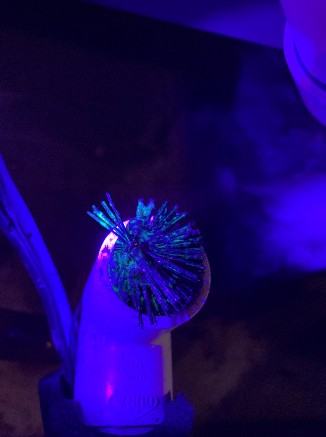
Adding UV dye to the refrigerant is not really a solution within itself, but it can make it easier to locate the source of a leak within your system. It can take anywhere from 3-14 days on average, depending on the severity of the puncture, to fully circulate and show results. The technician uses a blacklight to see the dye, which glows. It is not fool-proof, as some leaks can be located behind walls and won’t be located by the blacklight.
Following the discovery of the leak, the line set will need to be drained, the repair will be made, and the refrigerant will be recharged. It can be an expensive and time-consuming process in the end that can yield no results.
Average Results: Immediate
Solution: Semi-Permanent
Intensity: Moderate
There is a tool that can detect refrigerant, similar to how a metal detector can find metal. Upon discovery, the potential repair can be identified. Depending on how your refrigerant lines are set up and where the leak is located, it could require a coil or condenser be replaced or a line set joint be mended.
As there can be multiple leaks within older systems, there is no guarantee that this will be the end to the leak.
Pressure Test
Average Results: 2-5 hours
Solution: Most Permanent
Intensity: Difficult
If your system is already out of refrigerant, one of the best options you can opt for is a pressure test. The technician will put nitrogen into the lines to determine where the leak is but tracing the lines and listening for the air seeping out. This process is repeated if necessary until the system holds the nitrogen without losing pressure.
Most reputable HVAC companies like Rostron Premium Home Services will also use pressure testing after repairs are completed to see if there are any other identifiable leaks.

Replacement of the System
Average Results: Immediate
Solution: Most Permanent
Intensity: Difficult
Replacing the full HVAC system is sometime the best option for refrigerant leaks. As you can see, there are a number of steps that need to be completed to even identify the leak. Depending on the age and condition of the rest of the system, parts may be discontinued and the unit cannot be repaired, meaning the difficult process leads to a dead end.
The best option is to replace the full HVAC system along with the refrigerant lines, but at the very least, the line set should be tested to ensure there are no leaks. This is much easier during the install process than it is during a repair attempt.
When is The Best Time to Tackle a Refrigerant Leak?
The best time to take care of a leaking AC system is during mild temperatures, as the process can take quite some time and will leave your Jersey Shore home without air conditioning during the repairs and testing. If you had an issue in the prior season, having an AC maintenance completed in late Winter/early Spring (February/March) is one of the best things you can do to prevent downtime during the season.
Rostron Premium Home Services offers cooling, heating, plumbing, and electrical services for Monmouth and Ocean Counties in New Jersey. Having trouble with your AC system? Give us a call at 732-223-8221 or fill out a form right here on our website!